NewsPublished 6 min read
Brazil's Central Bank: Pix MED will separate scams from commercial disputes
In Brazil, the Central Bank changed what banking apps must do in the MED, the refund mechanism of Pix, Brazil's instant payment system. From March 1, 2027, the app screens each claim before it's filed, separating scams from commercial disputes and buyer's remorse, and the receipt starts showing the trade name of a business that receives with a CNPJ.
 By LibertyBot TeamLibertyBot Blog
What changed
In Brazil, the Central Bank published BCB Normative Instruction No. 774, of September 3, 2026, in the Federal Official Gazette of September 4. It releases version 7.4 of the Minimum Requirements for User Experience, the part of the rules of Pix, the country's instant payment system, that says what each bank's and payment institution's app has to show the customer. Version 7.4 takes effect on March 1, 2027 and replaces version 7.3, the one in force today.
The change log describes a general overhaul of the MED self-service chapter, the area of the app where the customer contests a Pix. The MED (Special Return Mechanism) is the Pix rule for returning money to victims of scams. For contesting a payment, it looks like this:
| Point | Today (version 7.3) | From March 1, 2027 (version 7.4) |
|---|---|---|
| Situations outside the MED | The bank may offer them as answer options: it's only a recommendation | Mandatory screening, with these situations right at the start |
| Customer who picks a type of scam | The bank records it and opens the funds recovery right away | The bank assesses the case before opening the recovery |
| Deadline to contest | 80 days from the date of the Pix | 80 days from the date of the Pix |
What changes for sellers
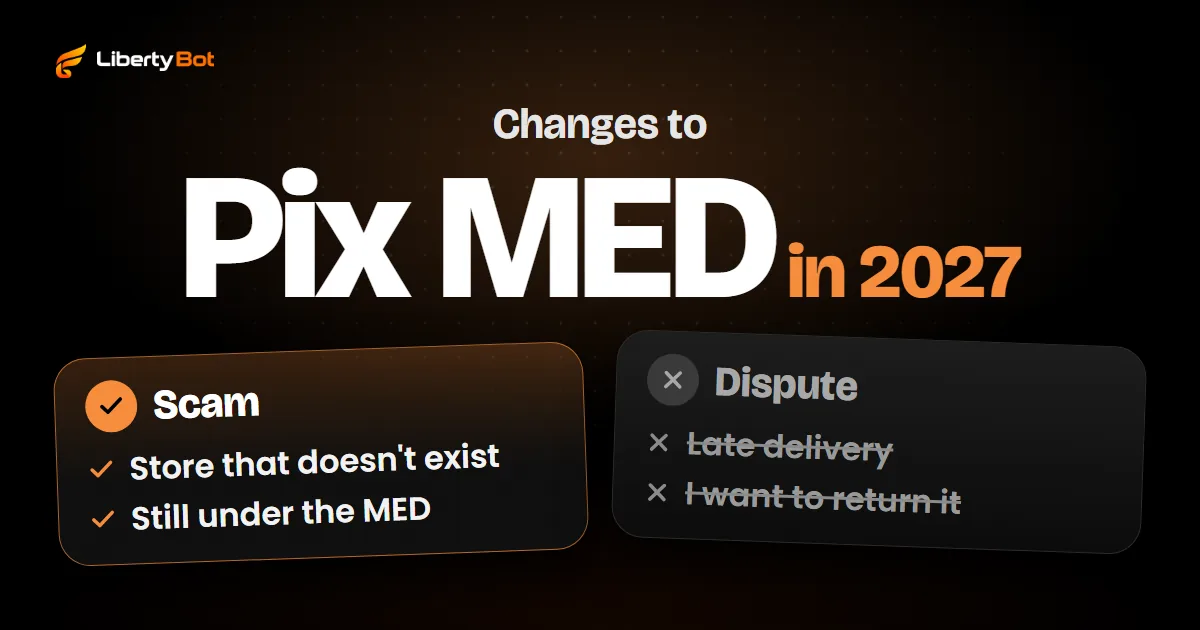
The screening separates scams from commercial disputes
When choosing a Pix to contest, the customer goes through a screening, preferably a step by step with questions, that separates what the MED covers from what it doesn't. Each situation comes with an explanation. The document gives these examples of situations outside the MED:
- a commercial disagreement between buyer and seller;
- a Pix sent to the wrong person or company;
- regret over having made the Pix.
In the document's sample questions (translated from Portuguese), "I made a purchase and want to return the product" and "I made a Pix and regret it" appear as outside the MED. Whoever picks a situation like that is told the request won't become a MED claim. The bank explains the other options, without promising a refund.
The warning itself isn't new: today the app already has to say, at least on first access, which situations the MED doesn't cover, and the document's sample text mentions a commercial disagreement that can't be characterized as seller fraud, such as a product delivered late or that didn't meet the buyer's expectations. With version 7.4, the warning appears every time the customer goes to contest, and the sample text now says that filing the claim doesn't guarantee a refund. And the screening comes before the claim is filed.
Picking “scam” isn't enough
Whoever picks scam has to give more information about what happened: a free-text account, a guided questionnaire, both or another method the bank chooses. The buyer's bank has to assess everything the customer reported, including the option picked and the account, and can check whether one matches the other. If there's enough evidence that the case isn't a MED case, it doesn't open the funds recovery, even if the customer picked scam. The bank can also ask the customer to declare that the information is true before filing; that's a recommendation, not an obligation.
A real scam still falls under the MED. The document cites "I made a purchase and didn't receive the goods" as a case that calls for more questions: it may be a late delivery, which is a commercial disagreement, or a store or product that doesn't actually exist, which is a scam.
When a Pix you received is returned
If a Pix received in your account is returned through the MED, the institution holding that account now has to provide a receipt for the debit. It's marked as a MED return, with the amount and date of the original Pix, the return ID, the amount and date of the debit and the name of whoever got the money back.
The document's sample screening also has an option for someone who received a Pix and had the amount returned after a claim they consider wrongful. It's classified as a scam. The list is only an example: each bank builds its own.
The receipt shows the trade name
When the receiver is a company with a CNPJ (the Brazilian company taxpayer ID), the screen before confirming the Pix already shows the company's trade name, or its registered name if there's no trade name. With version 7.4, the receipt starts showing the same name. And the receipt keeps only the Pix details: the new version prohibits advertising, publicity, offers, links and any content that isn't part of the transaction.
A receipt is still not proof of payment for releasing access: see why you check on the gateway, not on the receipt.
What to do now
See the name the buyer sees
Pay a charge from your own bot and look at the name on the screen before confirming the Pix. The screen already shows the trade name, or the registered name if there isn't one; from March 1, 2027, the receipt follows the same rule. If the name doesn't look like your business, check with your gateway or your bank how the receiving account is registered.
Tell buyers the name before they pay
If the receiver's name is different from the name in the offer, say in the Pix message which name will show up in the buyer's app.
Make your refund policy clear
Regret and commercial disagreements are outside the MED. Say in the offer how you handle refund requests and how the buyer can reach you.
On LibertyBot
LibertyBot doesn't touch the banking app or the receipt. What it already does with refunds and disputes:
- When the gateway reports that a paid sale was refunded or disputed, the sale changes to Refunded or Chargeback in Finance, and the bot revokes the access from that purchase: in the plan's VIP group or channel, it removes the buyer and cancels their invite. A link or message already delivered can't be taken back.
- You get the alert in the dashboard's bell and, with notifications turned on, on your phone: Dispute opened or Payment refunded. Both come turned on.
- The /suporte command shows the buyer the @username you add in the flow's @ Support field. Without that @username, the bot replies that support isn't set up.
Each gateway reports in its own way. Check with yours whether it notifies you when a Pix is returned through the MED.
Frequently asked questions
What is the Pix MED?
It's the Special Return Mechanism (Mecanismo Especial de Devolução), the Pix rule for returning money to victims of scams, fraud or crime. The customer files the claim in their own banking app.
Who has to follow these rules?
The banks and payment institutions that offer Pix: the document says how their apps have to work. It doesn't create obligations for sellers.
Sources (checked on )
- Central Bank of Brazil: BCB Normative Instruction No. 774, of September 3, 2026 (in Portuguese) (opens in a new tab)
- Central Bank of Brazil: Pix Minimum Requirements for User Experience, version 7.4 (PDF, in Portuguese) (opens in a new tab)
- Central Bank of Brazil: Pix Minimum Requirements for User Experience, version 7.3, the one in force today (PDF, in Portuguese) (opens in a new tab)